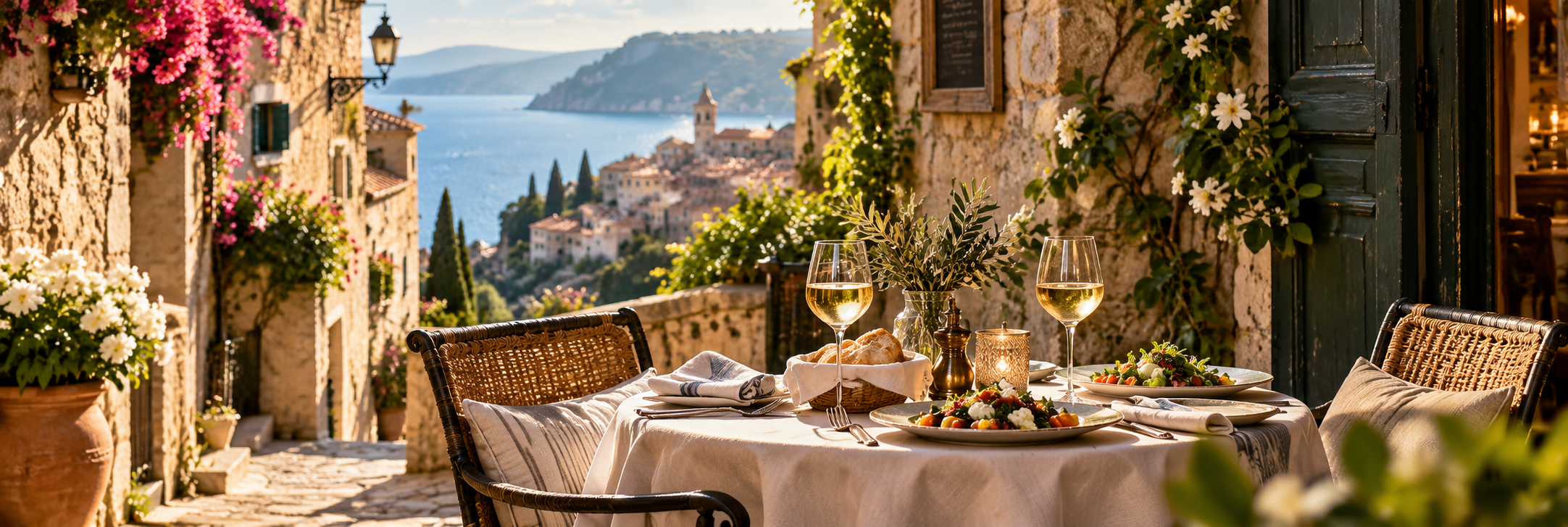
Places & Discoveries
by Nan Everidge
Every Place Has a Story. The Best Journeys Begin When We Discover It
There is something irresistible about a street that disappears around a corner.
Perhaps it leads to a centuries-old courtyard, a neighborhood bakery, a tiny art gallery, or a shop filled with objects whose stories are as interesting as the people who made them.
Or perhaps it leads nowhere particularly remarkable.
That’s part of the adventure.
I’ve always enjoyed the anticipation of discovering what lies beyond the familiar. It’s one of the reasons I love traveling, whether exploring a great international city, a historic European village, or a small American town that rarely appears on anyone’s must-see list.
The most interesting places aren’t necessarily the most famous.
Sometimes they’re the places that make you wonder: What’s the story here?
And once you begin asking that question, even an ordinary street can become an invitation to explore.
The Streets Have Something to Say
Consider the remarkable variety of places we encounter when traveling. In Italy, a narrow passageway between weathered buildings might lead to a small piazza where neighbors have gathered for generations. In San Francisco, a walk through Chinatown reveals an American neighborhood shaped by immigration, entrepreneurship, cultural traditions, and the determination of successive generations to establish a vibrant community. In Tokyo, a busy shopping district might be only a short walk from a quiet shrine, a traditional garden, or a small restaurant that has served its neighborhood for decades.
These places tell stories that extend far beyond their architecture. They tell us about people.
Who built the neighborhood? Why did they settle here? What traditions did they bring with them? What has changed, and what has survived?
The answers often reveal more about a destination than its most celebrated attractions. And the wonderful thing is that you don’t have to be a historian to appreciate them. You have to be curious.
Cinque Terre: Five Villages, Five Personalities
One of the places that first comes to mind when I think about destinations with character is Cinque Terre, along Italy’s Ligurian coast.
The five villages – Monterosso al Mare, Vernazza, Corniglia, Manarola, and Riomaggiore – share a spectacular coastal setting, yet each has developed its own personality.
Monterosso is known for its beaches and comparatively spacious waterfront. Vernazza is celebrated for its picturesque harbor. Corniglia sits dramatically above the sea, while Manarola and Riomaggiore offer their own distinctive mix of colorful buildings, narrow streets, and coastal scenery.
What makes this region especially fascinating is the relationship between its geography and its history.
For generations, residents cultivated steep hillsides, creating terraces supported by dry stone walls. Fishing, agriculture, and maritime connections helped shape communities that adapted to a demanding coastal environment.
Today, those landscapes are part of the region’s cultural identity.
On our Mediterranean cruise aboard the Disney Magic, we have the opportunity to experience a small part of this extraordinary coastline.
I remember a wonderfully leisurely three-hour lunch overlooking the Mediterranean, followed by time wandering among historic buildings and soaking up the villages' atmosphere.
But what interests me about Cinque Terre today is the story behind that beautiful setting.
How did these communities adapt to such challenging terrain? What does it take to preserve historic buildings and agricultural terraces? How do residents maintain their traditions while welcoming visitors from around the world?
Those questions transform Cinque Terre from a beautiful destination into a place worth understanding.
And they offer reasons to return.
San Francisco: A City Best Discovered Neighborhood by Neighborhood
San Francisco offers a clear example of how history and geography shape a destination’s character.
Its neighborhoods are remarkably diverse, each reflecting different periods of the city’s development.
The California Gold Rush transformed San Francisco in the nineteenth century, attracting people from across the United States and around the world.
Immigration, maritime commerce, technological innovation, and cultural change continued to shape the city over subsequent generations.
Today, those influences remain visible in its architecture, businesses, museums, restaurants, and public spaces.
Chinatown is a particularly compelling example.
Established during the Gold Rush era, it became a center of Chinese American community life, commerce, and cultural identity. Its history includes remarkable entrepreneurship and resilience, as well as periods of discrimination and exclusion.
For visitors, exploring Chinatown can be both a culinary pleasure and an introduction to an important chapter of American history.
During our visit, we enjoyed a pepper-crusted lobster dinner there that was to die for.
But I would encourage travelers to explore beyond a single meal.
Look at the architecture. Visit the shops and galleries. Learn about the neighborhood’s history. Discover how generations of families and business owners have contributed to its identity.
The same approach works elsewhere in the city.
San Francisco’s cable cars are enjoyable transportation experiences, but they are also surviving examples of a nineteenth-century urban transit system.
Alcatraz is a fascinating historic site, but its story extends beyond its years as a federal prison. The island also played an important role in Native American activism during the occupation that began in 1969.
The waterfront reflects San Francisco’s maritime heritage, while its galleries and cultural institutions reveal the creative traditions of a city that has continually reinvested itself.
On our visit, we enjoyed oysters and wine along the waterfront, explored art galleries, and ventured into Napa and Sonoma wine country.
Each experience revealed another side of Northern California.
What makes San Francisco particularly rewarding is that no single attraction tells the whole story. The city is best understood through its neighborhoods and the people who have shaped them.
Tokyo: A Thousand Discoveries in One City
Tokyo offers perhaps the most extraordinary contrast between the familiar and the unexpected.
My experience there was especially meaningful because I had the opportunity to work in Japan with Disney, which gave me a perspective that went beyond a typical vacation.
Tokyo is enormous, energetic, and endlessly fascinating.
Yet one of its most appealing qualities is the way individual neighborhoods develop distinctive identities.
Ginza is internationally associated with shopping, department stores, and sophisticated retail experiences. Asakusa retains a strong connection to traditional Tokyo, with Sensō-ji temple, historic shopping streets, and cultural attractions that introduce visitors to an earlier period of the city’s development. Shibuya is known for its extraordinary pedestrian activity, entertainment, fashion, and contemporary urban energy.
And neighborhoods such as Yanaka offer opportunities to explore a quieter side of Tokyo, where older streets, small shops, and traditional businesses provide a different perspective on the metropolis.
What fascinates me about these contrasts is how naturally they coexist.
A visitor can experience cutting-edge technology, contemporary architecture, and bustling entertainment districts, then discover a peaceful garden or a traditional restaurant nearby.
Tokyo also rewards attention to small details.
The presentation of food, the organization of shops, the variety of specialty retailers, and the care devoted to everyday services can make ordinary activities interesting.
But the city is not simply a showcase of efficiency or tradition. It is a living, evolving community with a complex history, diverse neighborhoods, and countless stories.
For anyone visiting Tokyo, my suggestion is to explore at least one neighborhood that isn’t at the top of the usual sightseeing itinerary.
Spend time walking. Stop somewhere interesting. Try a restaurant you might otherwise overlook. You may discover a side of the city that becomes your favorite memory.
The Story Behind the Shop
One pleasure of exploring an unfamiliar destination is discovering businesses that have become part of a community’s identity.
I’m particularly drawn to independent shops, small restaurants, family-owned establishments, and businesses that reflect local craftsmanship.
A bookstore in a historic building. A bakery whose recipes have been handed down through generations. A ceramics studio where traditional techniques remain part of the creative process. A family restaurant that serves dishes associated with its region.
These businesses often reveal something important about the places where they operate. They may preserve cultural traditions, support local artisans, or provide gathering places that help define that memorable neighborhood.
Of course, not every old shop is extraordinary, and not every new business lacks character. Some of the most exciting discoveries involve contemporary entrepreneurs finding creative ways to interpret local traditions.
The important question is not simply how long a business has existed. It’s what that business contributes to the place.
When I encounter an interesting establishment, I want to know who created it, what inspired them, and why they chose that particular community.
Those stories can make a purchase, a meal, or a brief visit considerably more meaningful.
The Places History Nearly Forgot
Some destinations have fascinating histories that remain relatively unknown to visitors.
Consider the small towns scattered across Europe whose buildings reveal centuries of changing political boundaries, commercial relationships, and cultural influences.
Or American communities that once flourished because of a railroad, port, mining operations, or agricultural industry.
Some have reinvented themselves as cultural destinations. Others have preserved historic districts that offer intriguing glimpses into earlier ways of life.
Even major cities contain overlooked historic sites.
A modest memorial may commemorate an event that changed a community. A former industrial building may have become an arts center. A neighborhood church may reflect the history of immigrant families who have established new lives far from their countries of origin.
These are the places I want The Art of Somewhere to explore.
Not simply because they’re unusual, but because their stories help us understand the communities around them.
Travel can be a wonderful introduction to history, especially when we encounter it where events actually happened.
And sometimes the most fascinating stories are the ones we didn’t know we were looking for.
Discovering a Place Through Its People
Buildings, landscapes, and historic attractions are important. But the people who live and work in a destination often provide the most revealing perspective.
A local guide can explain how a neighborhood changed. A restaurateur may share the origins of a regional dish. An artist can describe the traditions that influence their work. A hotelier may explain why a particular building was preserved or how its history shapes the guest experience.
These conversations can provide insights that no brochure or promotional website could fully capture. They can also challenge our assumptions.
A destination that appears idyllic to visitors may face serious challenges involving housing, infrastructure, environmental preservation, or the pressures of tourism.
Understanding those realities doesn’t diminish the experience. It adds depth.
I believe thoughtful travel journalism should celebrate what makes a place special while remaining curious about the circumstances that shape everyday life.
The best destination stories aren’t simply advertisements for beautiful places. They’re opportunities to understand them/
A Little Planning, a Little Serendipity
Of course, curiosity works best with a little practical preparation.
Before exploring a destination, I like to learn enough about its history and geography to understand what makes it distinctive.
Identify a few important landmarks.
Research neighborhoods that reflect different aspects of local culture. Look for independent restaurants, galleries, markets, and historic sites. Learn something about local transportation and customs.
Then leave room for the unexpected.
A carefully planned morning might include a historic neighborhood and a museum. But perhaps the afternoon should remain open.
That gives you time to follow an interesting street, linger over lunch, or accept a recommendation from someone who knows the area.
I don’t believe travelers must choose between organized sightseeing and spontaneous discovery. The most rewarding journeys often combine both.
What We’ll Be Looking For in Places & Discoveries
As The Art of Somewhere grows, I want this part of our publication to become a place for exploring destinations through the stories that make them distinctive.
We’ll look beyond familiar landmarks to discover historic neighborhoods, local businesses, cultural traditions, remarkable architecture, and places that deserve a closer look.
Some stories will take us to celebrated international destinations. Others may lead to small communities, unexpected discoveries, or fascinating places much closer to home.
We’ll explore the history behind each destination, the people who shape its identity, and the experiences that help visitors appreciate its character. And we’ll share practical observations that make it easier for readers to explore these places themselves.
Not every discovery will be a luxury experience. Not every destination will be famous. And not every story will end with a glowing recommendation. But each should offer something worth learning because a great destination feature should do more than make a place look attractive.
It should help readers understand why that place is interesting.
The Invitation to Explore
There’s a certain pleasure in arriving somewhere new with a few plans and a great deal of curiosity. You know the places you’ve come to see.
You may have reservations at a wonderful restaurant or tickets to an important attraction. But you don’t yet know which small discoveries will become your favorite stories.
Perhaps it will be a neighborhood you hadn’t planned to visit.
A local shop with an interesting history. An unexpected architectural detail. Or a conversation that changes the way you understand a place.
Those are the possibilities that make exploring so enjoyable.
Through Places & Discoveries, I hope to share not only the destinations I visit, but the fascinating stories waiting to be uncovered within them because wherever we travel, there is always more to discover than what appears on the map.
Sometimes the most interesting part of going somewhere is finding out what has been there all along.